

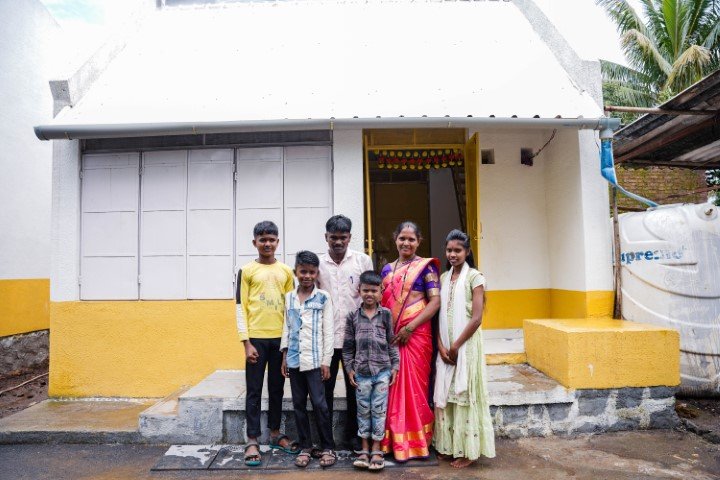
Earthquake-Resistant Housing Development Project
Budhada, Latur District, Maharashtra (1993)
Following the devastating Latur Earthquake of 1993, Maharashtra Social Housing and Action League (MASHAL) initiated an innovative Earthquake-Resistant Housing Development Project in Budhada village, Latur district. The project was undertaken to address the urgent need for safe, affordable, and culturally appropriate housing solutions for families affected by the disaster.
The earthquake caused widespread destruction across the region, leaving thousands of families homeless and highlighting the vulnerability of traditional housing structures to seismic events. In response, MASHAL developed and demonstrated alternative housing technologies that combined disaster resilience with affordability and local resource utilization.
Project Objectives
The project aimed to:
- Develop earthquake-resistant housing solutions suitable for rural communities.
- Utilize locally available materials and traditional construction knowledge.
- Promote affordable and sustainable reconstruction methods.
- Demonstrate safer building technologies to earthquake-affected communities.
- Encourage community participation in housing reconstruction.
- Build local capacities in resilient construction practices.
Development of Earthquake-Resistant Housing Technologies
MASHAL undertook extensive experimentation and field demonstrations to develop housing systems capable of withstanding seismic forces while remaining affordable for rural households.
The housing models incorporated locally available materials, including:
- Stone masonry
- Mud construction
- Bamboo reinforcement
- Galvanized Iron (GI) sheets
- Timber and locally sourced building components
These materials were combined with improved construction techniques designed to enhance structural stability and reduce the risk of collapse during future earthquakes.
The housing technologies and construction methodologies developed by MASHAL underwent technical review and received approval from leading national institutions, including:
- Central Building Research Institute (CBRI), Roorkee
- Indian Institute of Technology (IIT), Powai, Mumbai
The endorsement from these institutions validated the technical soundness and safety of the proposed construction systems.
Community Participation and Demonstration
MASHAL adopted a participatory approach by involving local residents in the planning, design, and construction process. Demonstration houses were constructed to showcase the effectiveness of the earthquake-resistant technologies and to build confidence among affected families.
The innovative housing designs generated significant interest within the local population and stimulated discussions regarding safer building practices, disaster preparedness, and long-term settlement development.
The project also provided opportunities for local artisans, masons, and community members to learn improved construction techniques that could be replicated in future housing initiatives.
Outcomes and Impact
The project successfully demonstrated that earthquake-resistant housing could be developed using locally available materials and community-based construction methods. Key achievements included:
- Development of technically approved earthquake-resistant housing models.
- Promotion of safer and more resilient construction practices.
- Increased awareness regarding disaster-resistant building technologies.
- Capacity building of local communities and artisans.
- Establishment of a replicable model for post-disaster rural housing reconstruction.
The success of the initiative strengthened MASHAL’s engagement in the earthquake rehabilitation programme and led to its continued involvement in reconstruction efforts across affected regions of Maharashtra.
Village Reconstruction and Housing Rehabilitation Project
- Lohara and Villapur, Osmanabad District, Maharashtra (1994)
Building upon the successful experience gained through the Budhada Earthquake-Resistant Housing Project, MASHAL provided technical leadership and planning support for the reconstruction of earthquake-affected villages in Lohara and Villapur, located in Osmanabad district, Maharashtra.
The project was implemented in collaboration with local development organizations, including Chatra Yuva Bharati and Maharashtra Arogya Mandal, which sought MASHAL’s expertise in developing community-centered and disaster-resilient housing solutions for families affected by the 1993 earthquake.
Project Background
The earthquake had caused extensive damage to housing and community infrastructure in Lohara and Villapur, leaving numerous families without adequate shelter. Reconstruction efforts required solutions that were not only structurally safe but also economically viable and acceptable to local communities.
MASHAL adapted and refined the earthquake-resistant housing technologies previously developed in Budhada to meet the specific social, environmental, and cultural needs of the villages.
Project Objectives
The project focused on:
- Rehabilitating earthquake-affected families through safe housing reconstruction.
- Promoting community participation in rebuilding efforts.
- Utilizing local materials and traditional construction practices.
- Developing settlement layouts responsive to community needs.
- Enhancing disaster resilience in rural housing.
- Building local capacities in construction and maintenance.
Participatory Planning and Housing Design
MASHAL adopted a people-centered planning process that actively involved villagers in decision-making related to housing design, settlement planning, and reconstruction activities.
Extensive consultations were conducted to understand:
- Family size and housing requirements.
- Traditional living patterns and cultural practices.
- Livelihood needs and space utilization.
- Preferences regarding housing layouts and construction materials.
Based on these consultations, MASHAL modified and improved the housing models developed in Budhada to better suit local conditions and community aspirations.
Housing Reconstruction Approach
The reconstructed houses incorporated:
- Locally available stone and mud materials.
- Bamboo and timber elements for reinforcement.
- Improved structural detailing for earthquake resistance.
- Climate-responsive design features.
- Cost-effective construction methods.
- Flexible layouts suitable for rural family needs.
The project emphasized the use of local labour and community participation, enabling affected families to play an active role in rebuilding their homes and communities.
Capacity Building and Community Engagement
MASHAL worked closely with local residents, artisans, and community organizations to transfer knowledge related to safer construction techniques and maintenance practices.
Training and orientation programmes helped:
- Strengthen local construction skills.
- Promote disaster-resilient building practices.
- Encourage collective participation in reconstruction.
- Build community ownership of the rehabilitation process.
Outcomes and Impact
The project contributed significantly to the rehabilitation of earthquake-affected communities in Lohara and Villapur by providing technically sound, affordable, and community-accepted housing solutions.
Key outcomes included:
- Reconstruction of safe and resilient housing units.
- Adaptation and scaling of innovative housing technologies developed in Budhada.
- Increased community participation in reconstruction activities.
- Strengthened local capacities in disaster-resistant construction.
- Improved living conditions for affected families.
- Demonstration of sustainable and replicable village rehabilitation models.
Project Significance
The Village Reconstruction and Housing Rehabilitation Project in Lohara and Villapur further established MASHAL’s leadership in participatory post-disaster reconstruction and rural housing development. The initiative demonstrated how technical innovation, community participation, and local resource utilization could be effectively combined to create sustainable and resilient housing solutions.
The experience gained through these projects contributed to the evolution of MASHAL’s long-term work in housing, habitat development, disaster rehabilitation, community empowerment, and sustainable rural development across Maharashtra.